
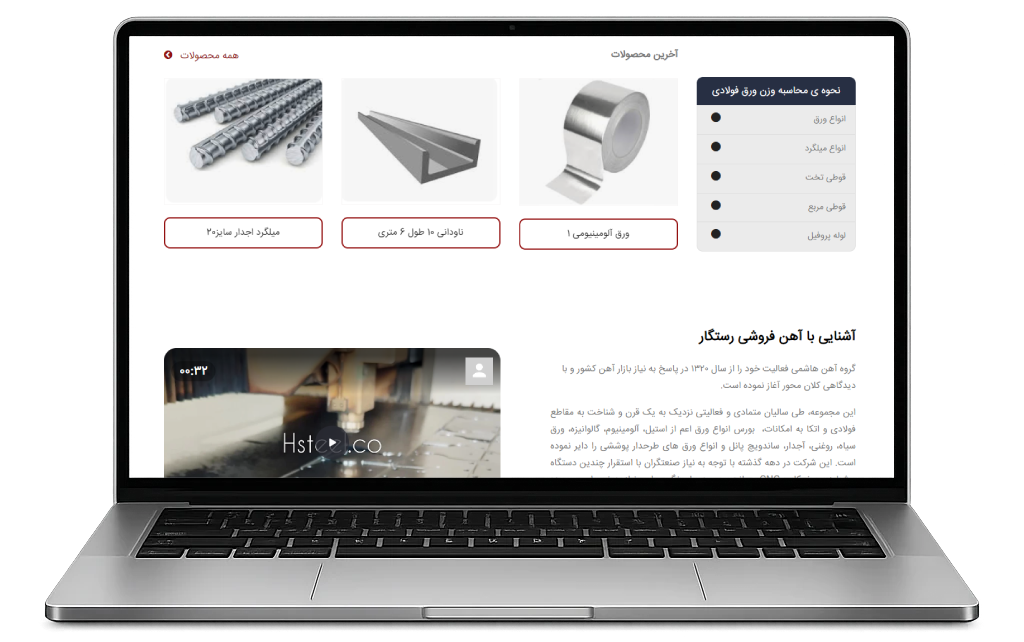
Overview:
Hashemi Iron Group began its activities in 1941 (1320 solar Hijri), in response to the Iranian iron market's demands and with a comprehensive vision.
Over the course of many years and nearly a century of operation, and by leveraging its expertise in steel profiles and its resources, the group has established a trading center for various types of sheets, including steel, aluminum, galvanized, black plate, oiled, checkered, sandwich panels, and various patterned coating sheets. In the past decade, in response to the needs of industrialists, the company has installed several laser cutting machines, CNC bending, and punching machines to optimally meet these demands.
Project Challenges
Every software project, beyond coding itself, involves a set of technical and business challenges whose proper management has a direct impact on the final success of the product.
Detailed Requirements Analysis
Translating the initial business needs into clear and implementable technical documentation required continuous interaction with stakeholders, receiving periodic feedback, and aligning business goals with technical solutions.
Choosing the Optimal Architecture
Designing a scalable, secure, and high‑performance architecture that allows for easy future development and maintenance was one of the key and most influential decisions in the project.
Integration with Existing Systems
Connecting and synchronizing the project with existing services, APIs, and infrastructures—without causing disruption in the active systems—required precise design and multi‑stage testing.
Performance and User Experience Optimization
Achieving balance between speed, system stability, and a smooth user experience— especially under heavy loads and simultaneous users—was one of the major challenges of this project.
Change Management and Scalability
Changing requirements and priorities during the development cycle is inevitable. Designing a flexible structure capable of managing these changes—without quality decline, cost increase, or technical risk—was one of the essential requirements of the project.